Understanding the Bikram Sambat (BS) Calendar
The Bikram Sambat (BS) calendar is the official, historical calendar of Nepal. While much of the world operates on the Gregorian (AD) system, Nepal's daily life, financial systems, and festivals are deeply tied to the lunar and solar cycles tracked by the BS calendar.
How Bikram Sambat Works
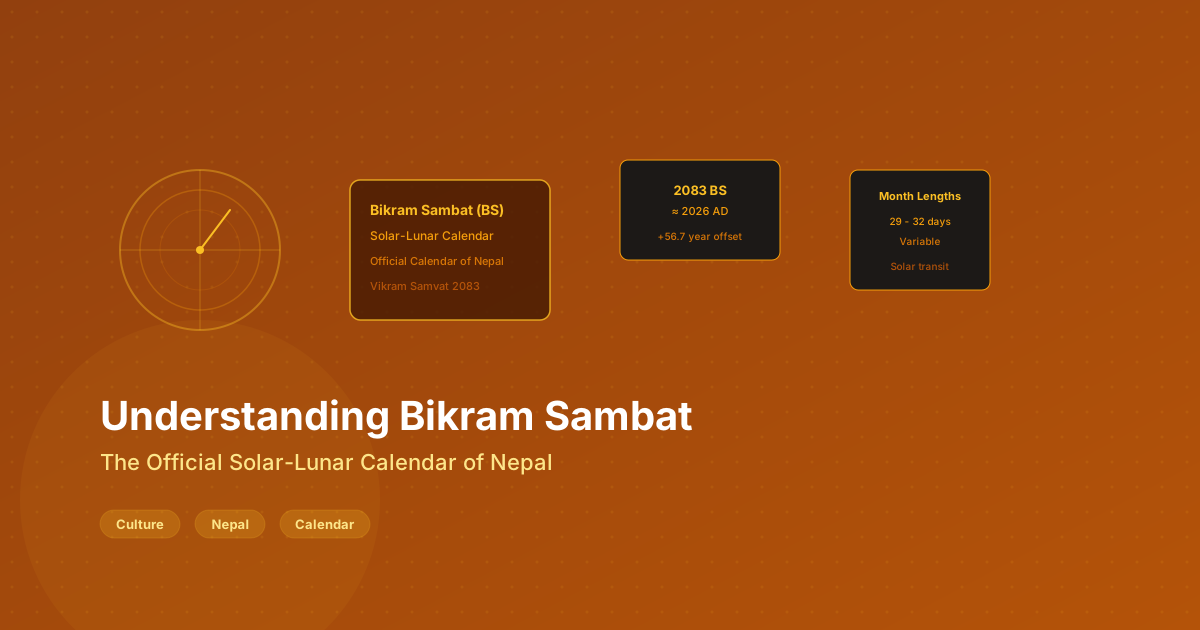
Unlike the Gregorian calendar, which has fixed leap years and predictable month lengths, the Bikram Sambat calendar is solar-lunar. A month in the BS calendar is determined by the time it takes the sun to transition through a zodiac sign (a "rasi"). Because the Earth's orbit is elliptical, this time varies.
This means a Nepali month like Baishakh or Kartik can have anywhere from 29 to 32 days, and it changes every single year! The Gregorian calendar, by contrast, has fixed month lengths (28-31 days) that repeat identically every year.
The 12 Months of Bikram Sambat
| Month | Nepali | Approximate Gregorian | Typical Days | |-------|--------|----------------------|--------------| | 1 | बैशाख (Baishakh) | April-May | 30-31 | | 2 | जेठ (Jestha) | May-June | 31-32 | | 3 | असार (Asar) | June-July | 31-32 | | 4 | साउन (Shrawan) | July-August | 31-32 | | 5 | भदौ (Bhadra) | August-September | 30-32 | | 6 | असोज (Ashoj) | September-October | 29-30 | | 7 | कार्तिक (Kartik) | October-November | 29-30 | | 8 | मंसिर (Mangsir) | November-December | 29-30 | | 9 | पुष (Poush) | December-January | 29-30 | | 10 | माघ (Magh) | January-February | 29-30 | | 11 | फागुन (Falgun) | February-March | 29-30 | | 12 | चैत्र (Chaitra) | March-April | 30-31 |
The Challenge of Conversion
Because the month lengths shift annually based on astronomical events, you cannot use a simple mathematical formula to convert an English date (AD) to a Nepali date (BS). The offset between the two calendars is not constant — it varies between 56 and 57 years depending on the specific date.
To build an accurate Nepali Patro (Calendar) or Date Converter, developers cannot rely on basic math. They must query a database of pre-calculated astronomical data for every specific year. This data includes the exact solar transit times for each year, which determine when each Nepali month begins and ends.
Why Does Nepal Use Bikram Sambat?
The Bikram Sambat calendar is over 1,900 years old. It was traditionally attributed to the legendary king Vikramaditya and was used across the Indian subcontinent. When Nepal modernized under the Rana regime, the BS calendar was retained as the official calendar — a symbol of national identity distinct from British-influenced India and the Western Gregorian system.
Today, BS is used for:
- Government offices — Official documents, tax deadlines, and fiscal year (which starts in Shrawan, around mid-July)
- Banking — Loan maturity dates, interest calculations, and account statements
- Festivals — Dashain, Tihar, Holi, and other festivals are scheduled by the BS calendar
- Legal documents — Birth certificates, land records, and court filings
- Daily life — Most Nepalis think of their age and birthday in BS
The Fiscal Year Quirk
One of the most confusing aspects for foreigners and new businesses in Nepal is the fiscal year. Nepal's fiscal year runs from Shrawan 1 to Asar end (roughly mid-July to mid-July). This means:
- A company's financial reporting period does not align with the calendar year
- Tax deadlines fall in Ashoj-Kartik (September-November)
- Budget announcements happen in Jestha (May-June)
- Salary increments and bonuses are often tied to the fiscal year end
This is why having an accurate date converter is essential for anyone doing business in Nepal.
How We Built Our Date Converter
At SecureX Lab, our Nepali Date Converter tools utilize highly accurate, backend astronomical engines. We use pre-calculated data tables that map every single day of the Gregorian calendar to its corresponding Bikram Sambat date, going back over 100 years.
This ensures that whether you are checking today's Tithi, planning for an upcoming Purnima (Full Moon), aligning your business schedule, or simply converting your birth date for official paperwork, you are getting the exact, cosmically aligned data.
Our tool also provides the Tithi (lunar day), Nakstar (lunar mansion), and other astrological information that many Nepalis consult before important events like weddings, housewarmings, or business launches.
The Lunar-Solar Balance
What makes the BS calendar fascinating from a technical perspective is its attempt to track both the sun and the moon simultaneously:
- Solar element — The months are defined by solar transits (the sun moving through zodiac signs). This keeps the calendar roughly aligned with the seasons.
- Lunar element — The Tithi (lunar day) is determined by the angular distance between the sun and moon. This is why Purnima (full moon) and Amavasya (new moon) fall on different dates each month.
This dual tracking means that two different "days" can be active at once — the solar month and the lunar Tithi. It is a sophisticated system that predates modern computers by nearly two millennia.
Practical Applications
Understanding the BS calendar is not just academic. It has real practical implications:
- Event planning — Weddings and festivals must be scheduled on auspicious Tithis
- Business operations — Invoicing, contracts, and compliance deadlines are in BS
- Travel planning — Public holidays (which follow BS) affect transportation and services
- Software development — Any app targeting Nepali users must support BS dates
- Legal compliance — Court filings and government submissions require BS dates
Whether you are a developer building Nepali software, a business owner managing operations, or simply someone curious about Nepal's rich calendar tradition, understanding Bikram Sambat is the first step to navigating Nepal's unique temporal landscape.
Festivals and the BS Calendar
Nepal's major festivals are all scheduled according to the BS calendar:
- Dashain — The biggest Nepali festival, falling in Ashoj/Kartik (September-October). The exact dates vary each year based on the lunar calendar.
- Tihar — The festival of lights, following Dashain by about three weeks in Kartik/Mangsir.
- Holi — The festival of colors, celebrated on the full moon of Falgun (February-March).
- Teej — A major festival for women, falling in Bhadra/Shrawan (August-September).
- Maghe Sankranti — Celebrated on the first day of Magh (January 14-15), marking the transition to longer days.
Using Our Tools
At SecureX Lab, we provide several tools to help you work with the Bikram Sambat calendar:
- Nepali Date Converter — Convert between BS and AD dates instantly
- Nepali Patro — View the full Nepali calendar with Tithi, Nakshatra, and festival information
- BS-AD Calculator — Calculate the difference between any two dates in either system
All tools use the same accurate astronomical data, ensuring consistency across your workflow.

Prabin Uprety
Founder, SecureX Lab • Full-stack developer and cybersecurity researcher based in Birtamode, Nepal
Prabin Uprety is the founder of SecureX Lab, a software development and SaaS company based in Birtamode-4, Jhapa, Nepal. With over 5 years of experience in full-stack development (React, Next.js, Django, Node.js), Prabin specializes in building privacy-first tools for Nepali users and contributing to the local open-source community. His work focuses on bridging the gap between advanced technology and practical, everyday needs — from secure document conversion to Bikram Sambat date utilities. Prabin holds a degree in Computer Science and regularly writes about cybersecurity, AI, and Nepal's digital transformation. Connect with him on LinkedIn or follow his work at securexlab.com.