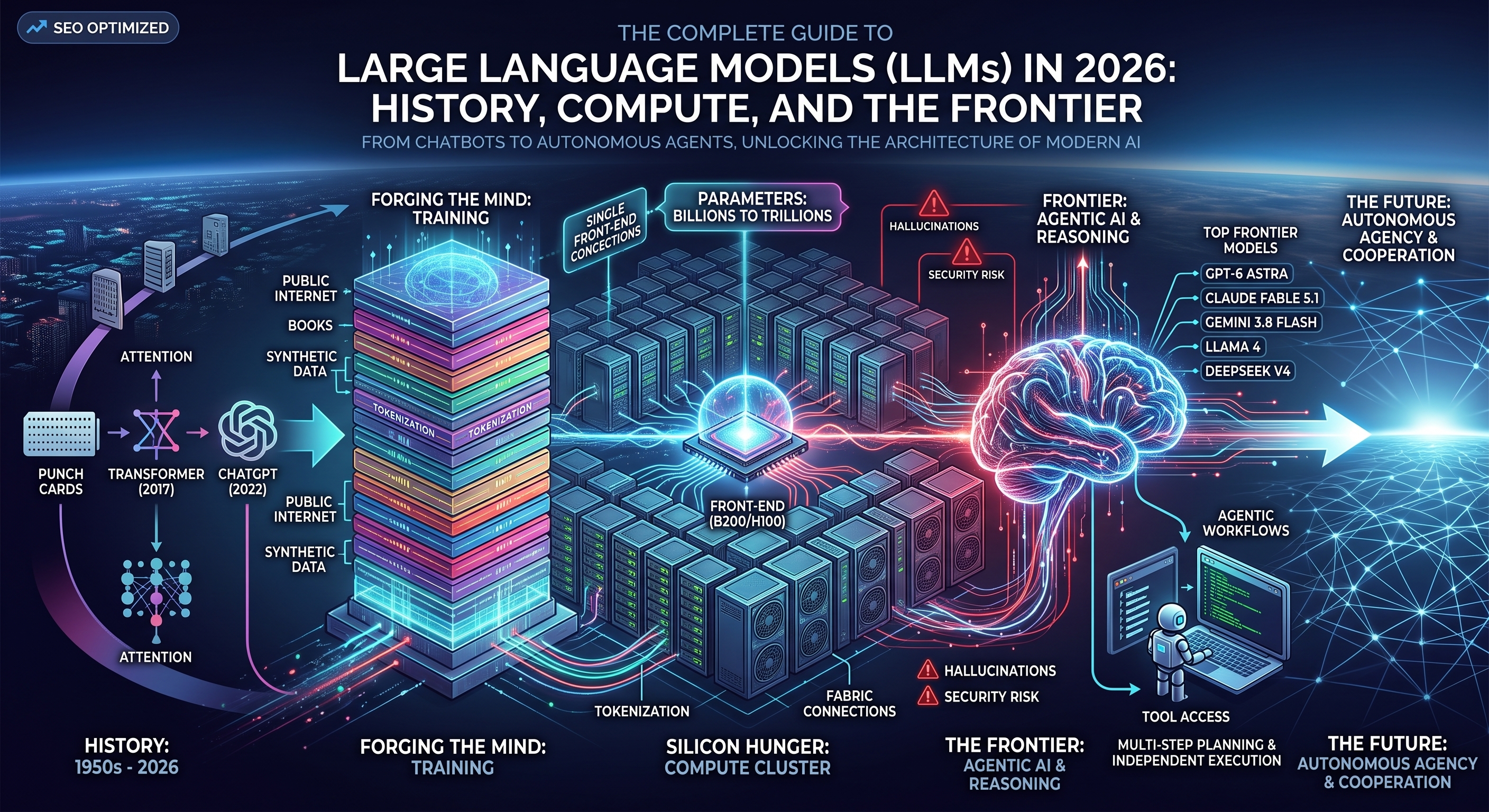
Large Language Models (LLMs) in 2026: History, Compute, and the Frontier
Artificial intelligence has irrevocably altered the foundation of modern technology. What began as an intriguing experiment in conversational software has rapidly matured into complex reasoning engines that power global enterprise workflows. The landscape of artificial intelligence has transformed dramatically since the initial public awakening in late 2022. We have long moved past simple chatbots answering trivia questions. Today, we exist in the era of agentic artificial intelligence, where models can autonomously plan, use digital tools, and execute multi-step tasks with minimal human intervention. This integration into our daily infrastructure is so deep that AI generated code now accounts for nearly 46 percent of new software, according to GitHub data from 2024. As these tools become foundational to everything from full stack software engineering to global logistics, understanding exactly how large language models function, how they are physically trained, and the immense computing resources they consume is critical for any technology professional operating in 2026.
Decoding the Architecture: What is a Large Language Model?
To truly grasp the capabilities of these digital systems, we must first look under the hood. At its core, a large language model is a highly sophisticated deep learning system trained on massive datasets of human text. The primary objective of these models is surprisingly singular and deceptively simple: given a specific sequence of words, the model must predict exactly what word comes next. This fundamental task of next-token prediction is the engine that drives everything from writing coherent essays to translating complex languages and reasoning through advanced mathematics.
The word "large" in large language models refers directly to the parameter count. Parameters are the adjustable mathematical weights that the neural network learns and refines during its extensive training phase. The scale of these neural networks is difficult to overstate. Modern models contain billions to trillions of parameters, with flagship systems like GPT-4 estimated at approximately 1.8 trillion parameters, and Claude 3 containing around 2 trillion parameters. These vast numbers of parameters allow the model to internalize intricate linguistic patterns, deep factual knowledge, and logical relationships without requiring explicit human labeling for every single training example.
The foundational technology that makes all of this possible is the transformer architecture, which was introduced to the academic world in 2017. The transformer serves as the absolute backbone of virtually all modern large language models. Its most revolutionary contribution was the attention mechanism, a computational technique that allows models to focus on the most relevant parts of the input data when generating an output. By using these self-attention mechanisms, the model can weigh the importance of different words in a sequence, effectively understanding context and subtle conceptual relationships across incredibly long passages of text.
The Deep Evolution: A History from 1950 to 2026
The journey toward today's digital intellect spans decades of incremental breakthroughs. The earliest theoretical foundations of artificial neural networks were established back in the 1950s. However, early natural language processing systems lacked both the data volume and the physical computational power to perform meaningful tasks, relying instead on rigid logic rules. The massive paradigm shift arrived with the aforementioned transformer revolution in 2017, which was subsequently followed by the highly publicized launch of ChatGPT in November 2022 that captured global public attention.
The period strictly between 2024 and 2026 witnessed an unprecedented acceleration in software development. In just 24 months, the landscape transformed entirely from a closed ecosystem dominated securely by GPT-4 into a democratized environment where open-source models routinely match proprietary frontier quality. During this brief two-year window, the imitation cycle, which measures the time it takes for an open-source model to replicate the intelligence capabilities of a proprietary frontier model, compressed drastically from 12 months down to a mere six weeks by 2025.
Simultaneously, the capacity for these models to retain working memory exploded. Between 2024 and 2026, context windows grew by an astonishing factor of 1,250, expanding rapidly from a baseline of 8,000 tokens to a staggering 10 million tokens. By 2025, pure conversational systems were effectively rendered obsolete as agentic models took over. These new systems were capable of running executing code, browsing the live internet, and natively controlling computer desktop interfaces. The technology sector reached a consensus by 2026 that text-only systems are officially deprecated, as every frontier model must now process images, audio, and video as standard native multimodal features.
The Silicon Hunger: Computing Capacity and Power
While the software architecture is elegant, the physical hardware required to train and run these models is brutal in its scale. Pretraining a large language model from scratch requires immense distributed computing power and typically consumes at least 248 enterprise graphics processing units, though many state of the art models consume well over 2000 units running concurrently.
At the center of this compute hunger is elite hardware like the NVIDIA H100 GPU. This highly specialized silicon features 16,896 CUDA cores and 80 gigabytes of high-bandwidth HBM3 memory, capable of delivering an incredible 3,000 teraflops of FP8 tensor performance. However, the memory constraints present a massive engineering hurdle for researchers. The parameter size of a modern model easily exceeds hundreds of billions, meaning a 175-billion parameter model demands around 350 gigabytes of hardware memory just to house the model weights. When you factor in the gradients and optimizer states required during the active training process, the memory requirement easily pushes beyond 1 terabyte.
Because a single advanced GPU like the H100 only holds 80 gigabytes of memory, developers are forced to partition the computational graph, splitting the model parameters and optimizer states across hundreds of discrete devices. Software integrations like Alpa and Ray enable automatic model parallelization and partitioning, allowing systems to scale successfully beyond 1,000 GPUs. Frameworks use complex dynamic programming algorithms for interoperator parallelism, and integer linear programming for intraoperator parallelism, ensuring the model fits within the strict memory limits of a single host. Benchmarks on advanced clusters like the NVIDIA Selene system demonstrated a peak hardware FLOPs utilization of roughly 57.5 percent, generating approximately 179 TFLOPs per GPU during training runs.
The electrical power consumption required for this massive infrastructure is staggering. A single NVIDIA H100 GPU is rated for 700 watts of power draw, but when factored into a data center cluster with the necessary server and networking overhead, it can consume up to 1500 watts per GPU. During inference, which is the process of actually generating an answer for an end user, it takes roughly 0.1 seconds of H100 compute time to process a standard query at absolute peak performance. However, typical utilization rates for real-world inference clusters hover around 10 percent, effectively increasing the necessary compute time to one full second of H100 processing per query. When factoring in an average power utilization rate of 70 percent across the hardware, processing a single query consumes approximately 1050 watt-seconds, which translates to about 0.3 watt-hours of electrical energy. Data centers operating on-premises are currently forced to build environments supporting 44 kilowatts of power and cooling capacity per server rack just to keep these clusters from failing.
Forging the Brain: The Multi-Stage Training Process
Creating a frontier artificial intelligence system is a monumental task carefully divided into several distinct phases. The very first phase requires data collection and tokenization, where numerical representations known as embeddings are generated. These embeddings capture the deep semantic meaning and invisible relationships between words.
The second phase is pre-training. During this resource-intensive stage, the model is fed enormous corpora of text data through self-supervised learning algorithms. The model processes trillions of text tokens, slowly adjusting its billions of parameters to minimize its error rate in predicting the next word sequence. The networking load here is heavy, requiring non-blocking fabrics like SHARPv3 enabled NDR connections to maximize throughput and share model weights across the cluster, preventing the GPUs from sitting idle while waiting for data. To increase scalability, static instructions are used to greatly reduce scheduling frequency and overhead at the controller level.
The third phase is fine-tuning, which carefully adapts the raw, highly unpredictable pre-trained model to specific tasks or enterprise domains using targeted training data. This phase is paired heavily with Reinforcement Learning from Human Feedback, a crucial modern training technique that relies on actual human preferences to align the output of the model with safe, helpful, and desired behaviors. Finally, modern intelligence models undergo specialized algorithmic training for logical reasoning using Chain-of-thought methodologies. In this approach, the model is explicitly trained to generate step-by-step reasoning logic invisibly before arriving at a final answer for the user. The introduction of chain-of-thought as a first class capability became a defining technological trend starting in late 2024, completely reshaping how models process complex prompts.
The Present Landscape: Frontier Models in 2026
As we navigate the middle of 2026, the artificial intelligence market is locked in a fierce pricing and capability war between closed proprietary corporate giants and highly capable open source alternatives. Open source models have effectively eaten the tech world. By the first quarter of 2026, highly compact models like Qwen3.5-9B were reliably outperforming massive 120-billion parameter systems built just a generation prior. DeepSeek R1 disrupted the entire industry by matching the elite reasoning capabilities of proprietary models while undercutting competitors by roughly 90 percent. The R1 model debuted at an incredibly low price of just $0.55 per million input tokens. This aggressive pricing strategy continued with DeepSeek V3.2-Exp, which costs only $0.028 per million input tokens on a cache hit, and $0.28 on a cache miss. Furthermore, Meta's Llama 4 brought a massive 10 million token context window to the public entirely for free, signaling to the market that frontier level text intelligence is essentially free to access.
The proprietary models, however, continue to push the absolute physical boundaries of speed, deep reasoning, and context window size. OpenAI launched GPT-5.4 in March 2026, featuring a vast context window exceeding one million tokens, alongside smaller, faster Mini and Nano variants tailored for quick tasks. Anthropic released Claude Opus 4.6 and Claude Sonnet 4.6 in February 2026. Claude Sonnet 4.6 offers native vision support, a 200,000 token context window, and deep reasoning capabilities at a competitive rate of $3.00 per million input tokens. Google also remains highly dominant in the enterprise space, maintaining a 2 million token context standard with their Gemini 3 release, while their lighter Gemini 2.5 Pro model provides advanced reasoning and a 1 million context window for just $1.25 per million input tokens. In response to varying demands, providers now heavily segment their catalogs by price, capability, latency, and context length. OpenAI categorizes its flagship families into sol, terra, and luna tiers, while xAI lists models ranging from grok-4.6 to grok-build-0.1, allowing developers to route specific workloads to the most efficient model rather than relying on a single expensive monolith.
Speed is increasingly becoming the defining metric for end-user experience. Time to First Token dictates how responsive a software application feels to a human operator. Extremely fast models like the GPT-4.1 Nano, Gemini 2.5 Flash Lite, and Mistral Small 3.2 are capable of generating their first token in under 500 milliseconds. Medium tier models balanced for logic and speed, like Claude Sonnet 4.6 and Gemini 2.5 Pro, typically take between 500 milliseconds and two full seconds. Conversely, heavy reasoning models executing deep logic, such as DeepSeek R1 and Claude Opus 4.6, take well over two seconds to begin outputting text. Financial costs for these queries are being further mitigated through prompt caching features, with most major flagship models now offering 50 to 90 percent price discounts when processing previously cached system context.
Real World Applications and Persistent Risks
The practical application of these technologies has completely redefined daily enterprise operations. Professional developers utilize LLM APIs constantly for sophisticated coding assistants, vast document summarization protocols, and high-fidelity language translation pipelines. Because frontier models now process images, audio, and video natively, we are seeing the rise of multimodal live APIs that can interpret a continuous video feed in real time and execute digital software commands.
However, severe risks remain deeply embedded within the technology. Hallucinations, the phenomenon where a model confidently invents incorrect factual information, continue to plague even the most advanced reasoning systems on the market. When the Google Gemini 3 Pro model does not actually know an answer to a query, it hallucinates a staggering 88 percent of the time, though Google managed to improve this specific failure rate down to 50 percent with the subsequent release of Gemini 3.1 Pro. Anthropic's Claude models currently hold the lowest rate of high-stakes confidence-contradicted answers among all the top five providers. In strictly regulated financial domains, these unreliabilities are highly pronounced, with 72.1 percent of complex financial queries causing direct disagreement across different frontier models.
These systemic failures are not just theoretical annoyances; they carry massive, tangible financial consequences for businesses. In an extensive survey published in October 2025, it was revealed that the average reported financial loss per organization stemming directly from artificial intelligence related incidents was a staggering 4.4 million dollars.
The Future Horizon
Looking ahead to the remainder of the decade, the trajectory of artificial intelligence points definitively toward highly autonomous systems and profound physical hardware optimization. The release of newer silicon architectures like NVIDIA's B200 GPUs is already demonstrating major improvements in the data center. These newer clusters are achieving up to 32 percent higher computational efficiency in TFLOPs per GPU, and faster training speeds compared to the older H100 generation, largely due to higher memory bandwidth and a larger streaming multiprocessor count. This hardware evolution is absolutely critical, as the sheer electrical energy demands of expanding data centers threaten to bottleneck future software scaling limits entirely.
The conversational chatbot era that defined 2023 is officially behind us. The future belongs to persistent digital agents that navigate complex operating systems, manage enterprise software integrations, and execute logical planning over extended multi-day timeframes. As open source developer communities continue to compress the frontier imitation cycle down to mere weeks, the ultimate beneficiaries will be the global developers and businesses who now have access to unprecedented digital intellect. We are standing at the absolute frontier of computational history, where the fundamental language of machines is no longer strict binary code, but the nuanced, beautifully complex language of humanity itself.

Prabin Uprety
Founder, SecureX Lab • Full-stack developer and cybersecurity researcher based in Birtamode, Nepal
Prabin Uprety is the founder of SecureX Lab, a software development and SaaS company based in Birtamode-4, Jhapa, Nepal. With over 5 years of experience in full-stack development (React, Next.js, Django, Node.js), Prabin specializes in building privacy-first tools for Nepali users and contributing to the local open-source community. His work focuses on bridging the gap between advanced technology and practical, everyday needs — from secure document conversion to Bikram Sambat date utilities. Prabin holds a degree in Computer Science and regularly writes about cybersecurity, AI, and Nepal's digital transformation. Connect with him on LinkedIn or follow his work at securexlab.com.