Demystifying Land Measurement in Nepal: Ropani, Bigha, and Square Feet Explained
Navigating real estate and property transactions in Nepal requires an understanding of a unique, dual-system land measurement standard. Unlike most countries that rely exclusively on the metric or imperial systems, Nepal uses traditional units that vary depending on the geographical region.
For developers, buyers, and civil engineers, understanding the exact mathematical relationship between the "Pahadi" (Hilly) system, the "Terai" (Flatland) system, and international standards is critical to avoiding costly financial errors.
The Hilly Region System (Ropani-Aana-Paisa-Daam)
Primarily used in Kathmandu Valley and the hilly regions of Nepal, this system is deeply rooted in historical land distributions. The base unit of this system is the Ropani.
Breakdown of Hilly Units
To calculate land in this region, the hierarchy is broken down into four tiers:
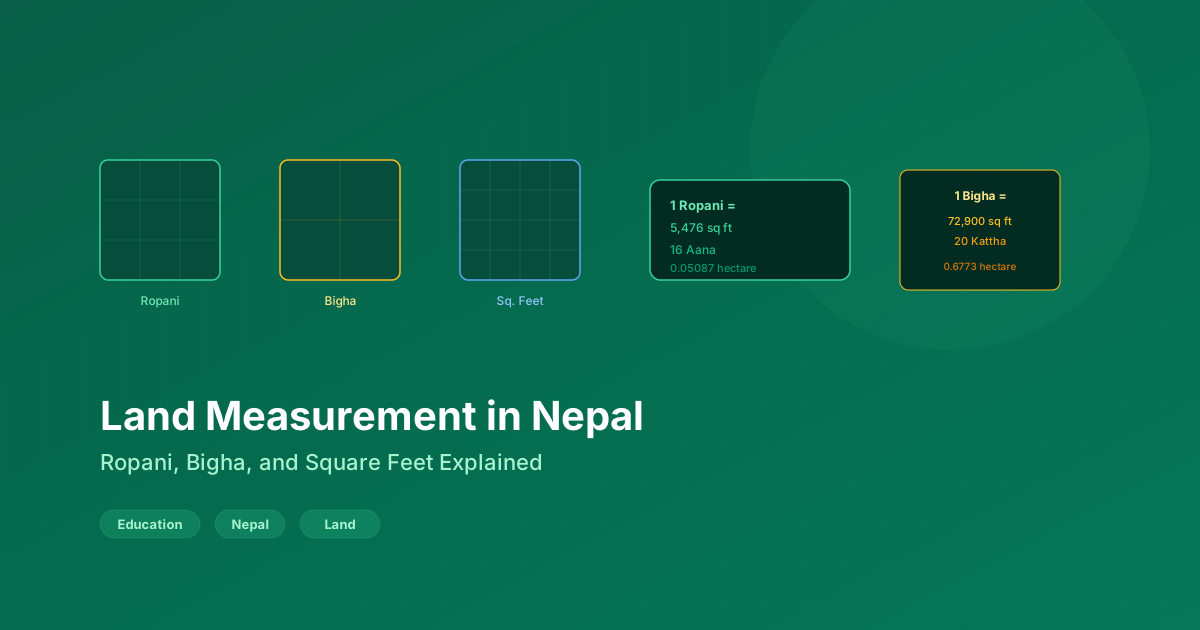
- 1 Ropani = 16 Aana
- 1 Aana = 4 Paisa
- 1 Paisa = 4 Daam
This means 1 Ropani = 16 Aana = 64 Paisa = 256 Daam.
International Conversions for the Hill System
When dealing with modern architectural blueprints, these traditional units must be converted to Square Feet (sq. ft) or Square Meters (sq. m).
- 1 Ropani = 5,476 sq. ft (or exactly 508.737 sq. m)
- 1 Aana = 342.25 sq. ft (or exactly 31.79 sq. m)
- 1 Paisa = 85.56 sq. ft
- 1 Daam = 21.39 sq. ft
The Terai Region System (Bigha-Kattha-Dhur)
In the southern plains (Terai) of Nepal, the agricultural expanses required a larger base unit for measurement. Here, the Bigha is the standard.
Breakdown of Terai Units
The Terai system is slightly simpler, utilizing a three-tier hierarchy:
- 1 Bigha = 20 Kattha
- 1 Kattha = 20 Dhur
This means 1 Bigha = 20 Kattha = 400 Dhur.
International Conversions for the Terai System
The Terai units are significantly larger than the Hill units, making manual conversion between the two regions prone to human error.
- 1 Bigha = 72,900 sq. ft (or exactly 6,772.63 sq. m)
- 1 Kattha = 3,645 sq. ft (or exactly 338.63 sq. m)
- 1 Dhur = 182.25 sq. ft (or exactly 16.93 sq. m)
Why Accurate Conversion is Mandatory
In modern Nepalese real estate, land valuation is highly granular. In the Kathmandu valley, a single Aana of land can be worth tens of millions of rupees. A manual miscalculation of a fraction of an Aana or Paisa can result in massive financial discrepancies during the drafting of a legal deed (Lalpurja).
Furthermore, when submitting building plans to local municipalities, engineers must submit layouts in square feet or square meters, requiring flawless conversion from the owner's traditional land deed.
Common Mistakes to Avoid
Even experienced professionals sometimes make these errors:
-
Confusing the systems — Using Ropani rates for Terai land or vice versa. Always verify which system applies to the specific district.
-
Rounding too early — Converting through multiple intermediate units and rounding at each step compounds errors. Always convert from the base unit.
-
Ignoring the Daam — In Kathmandu, even a single Daam matters. Do not round off small units in legal documents.
-
Using approximate values — Some old textbooks use rounded conversions (e.g., 1 Ropani = 5,400 sq. ft). Always use the exact values listed above.
-
Forgetting that Bigha varies — While Nepal's Bigha is standardized, the same term in India can mean different amounts. Always use the Nepali standard.
A Brief History of Nepal's Measurement Systems
The Ropani system dates back to the Licchavi period (approximately 400-750 CE). The word "Ropani" literally means "field" or "plot" and was originally based on the amount of land that could be sown with one mana (approximately 0.5 kg) of seed.
The Bigha system was introduced during the unification of Nepal under Prithvi Narayan Shah, when the Terai regions were incorporated. The Terai system was adapted from the Mughal measurement system used across northern India.
Despite multiple government attempts to standardize on the metric system, traditional units persist in everyday real estate transactions. This is partly cultural — people think in Ropani and Bigha — and partly legal, as historical land deeds (Lalpurja) use these units.
Cross-System Conversion
Sometimes you need to convert between the Hill and Terai systems directly:
- 1 Bigha = approximately 13.31 Ropani
- 1 Ropani = approximately 0.075 Bigha
- 1 Kattha = approximately 0.83 Aana
- 1 Aana = approximately 1.21 Kattha
These cross-conversions are useful when comparing property prices across regions. For example, if land in Kathmandu is priced at NPR 2 crore per Ropani and land in Chitwan is priced at NPR 15 lakh per Kattha, you can convert both to the same unit to compare accurately.
Automating the Math with SecureX Tools
Instead of memorizing these exact decimal values or relying on error-prone manual multiplication, modern professionals utilize automated algorithms. Our SecureX Land Converter allows users to seamlessly switch between Ropani, Bigha, and Metric units with zero data-loss, ensuring your legal and architectural documents are mathematically flawless.
Whether you are:
- Buying property in the Kathmandu Valley and need to verify the deed measurements
- A civil engineer preparing building plans for municipal submission
- A real estate agent comparing prices across regions
- A researcher studying land distribution patterns
Having an accurate, instant converter saves time and prevents the costly errors that manual calculations can introduce.
Frequently Asked Questions
Q: Which system applies to my land? A: It depends on your district. Kathmandu, Bhaktapur, Lalitpur, and most hilly districts use Ropani. Terai districts (Birgunj, Nepalgunj, Biratnagar, etc.) use Bigha. Some mid-hill districts may use either depending on local tradition.
Q: Can I use square feet instead of Ropani? A: Yes! Many modern listings in Kathmandu quote prices per square foot. However, legal deeds (Lalpurja) still use Ropani, so you will need to convert.
Q: How do I verify the land area stated in a deed? A: Use a reliable converter to translate the traditional units to square feet, then compare with a physical survey if possible. Discrepancies between deed and actual area are not uncommon.
Q: What is the smallest unit I should care about? A: In Kathmandu, even a single Daam matters at current land prices. In the Terai, Dhur is usually sufficient precision.
Using the SecureX Land Converter
Our Land Converter tool is designed for accuracy and ease of use:
- Enter the value in any unit (Ropani, Aana, Paisa, Daam, Bigha, Kattha, Dhur, or square feet)
- Instantly see the conversion in all other units
- Use the result for legal documents, price comparisons, or planning
The tool handles all the complex decimal precision automatically, so you never have to worry about rounding errors.

Prabin Uprety
Founder, SecureX Lab • Full-stack developer and cybersecurity researcher based in Birtamode, Nepal
Prabin Uprety is the founder of SecureX Lab, a software development and SaaS company based in Birtamode-4, Jhapa, Nepal. With over 5 years of experience in full-stack development (React, Next.js, Django, Node.js), Prabin specializes in building privacy-first tools for Nepali users and contributing to the local open-source community. His work focuses on bridging the gap between advanced technology and practical, everyday needs — from secure document conversion to Bikram Sambat date utilities. Prabin holds a degree in Computer Science and regularly writes about cybersecurity, AI, and Nepal's digital transformation. Connect with him on LinkedIn or follow his work at securexlab.com.