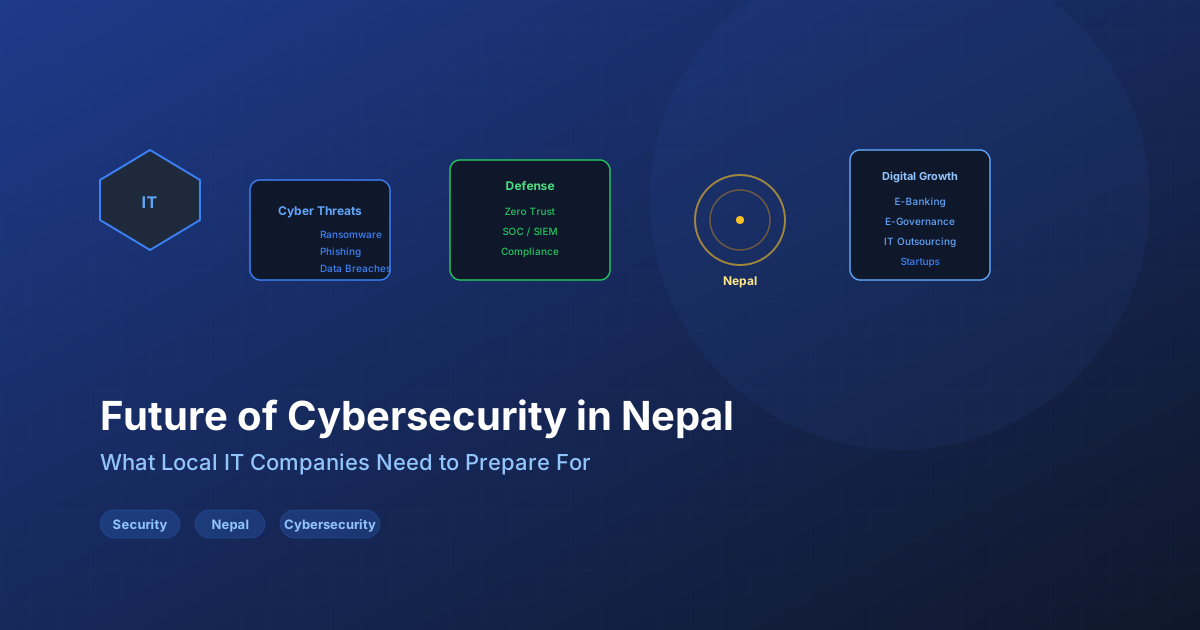
The Future of Cybersecurity for IT Companies in Nepal
Nepal is undergoing a massive digital transformation. From digital banking and e-governance to the rapid growth of local IT outsourcing companies, the nation is connected more than ever before. However, with digital growth comes the inevitable rise of cyber threats.
The Shifting Threat Landscape
Historically, many local businesses relied on basic firewalls and consumer-grade antivirus software. Today, the threats are much more sophisticated:
- Ransomware targeting small-to-medium enterprises
- Phishing attacks aimed at stealing employee credentials
- Vulnerabilities in custom-built, legacy web applications
- Supply chain attacks through third-party vendors
- Social engineering via WhatsApp and Facebook (widely used in Nepal)
According to the Cyber Bureau of Nepal (CIB), reported cybercrime incidents have risen sharply year over year. Yet many IT companies still operate without a dedicated security officer, a written incident response plan, or regular penetration testing.
The Cost of Ignoring Cybersecurity
For a small IT company in Kathmandu or Pokhara, a single ransomware attack can be devastating. The costs go far beyond the ransom demand:
- Business downtime — Systems may be locked for days or weeks
- Data loss — Customer records, project files, financial data can be permanently destroyed
- Reputation damage — Clients lose trust, especially if their data was exposed
- Legal liability — Under Nepal's Electronic Transactions Act, companies can face penalties for negligent data handling
- Recovery costs — Rebuilding systems from scratch, hiring forensic experts
A common misconception is that small companies are not targets. In reality, automated attacks scan every IP address on the internet indiscriminately. If your server has an unpatched vulnerability, it will be found — regardless of company size.
Moving from Reactive to Proactive
The old model of cybersecurity was reactive — waiting for a breach to happen and then trying to fix it. The new standard for IT companies must be proactive defense.
This includes:
Threat telemetry — Monitoring network traffic continuously for unusual patterns, such as a sudden spike in outbound data or login attempts at unusual hours.
Adaptive risk scoring — Assigning risk scores to different assets based on their sensitivity and exposure, then prioritizing protection accordingly.
Deception technology — Setting up "honeypots" (decoy systems) and tracking unauthorized internal movement. By placing fake credentials or files on the network, IT administrators can isolate attackers before they ever reach critical data.
Zero Trust Architecture — The principle of "never trust, always verify." Every user and device must authenticate and be authorized for each resource, even if they are already inside the network.
Building a Security Culture
Technology alone is not enough. The weakest link in any security system is usually human. A perfectly configured firewall is useless if an employee clicks a phishing link.
IT companies in Nepal should invest in:
- Regular security awareness training — Teach employees to recognize phishing emails, suspicious attachments, and social engineering attempts
- Clear security policies — Written rules for password management, device usage, data handling, and remote work
- Incident response drills — Practice what to do when a breach occurs, so the response is not panic-driven
- Multi-factor authentication (MFA) — Enforce MFA for all accounts, especially email, cloud services, and admin panels
The Regulatory Landscape
Nepal's government is gradually strengthening its cyber laws. The Electronic Transactions Act (2063) already criminalizes unauthorized access to computer systems, data theft, and cyber fraud. A more comprehensive Data Protection Act is in discussion, which would impose stricter requirements on how companies collect, store, and process personal data.
Forward-thinking IT companies should prepare for these regulations now rather than scrambling to comply later. This means:
- Documenting all data processing activities
- Implementing data minimization (only collect what you need)
- Having clear privacy notices for users
- Ensuring cross-border data transfers comply with future rules
SecureX Lab's Mission
Our core philosophy at SecureX Lab is to provide accessible, high-grade security tools and awareness. Whether we are developing proactive defense prototypes or providing secure utility tools for daily operations, our goal is to help secure Nepal's digital frontier.
We believe that cybersecurity should not be a luxury reserved for large corporations. Every business, school, hospital, and individual in Nepal deserves access to tools that protect their digital lives. That is why we build free, privacy-first tools — and why we share knowledge through articles like this one.
The future of cybersecurity in Nepal depends on awareness, preparation, and collective action. Start today: audit your systems, train your team, and make security a priority before a breach forces your hand.
Recommended Resources for Nepali IT Companies
- Nepal Computer Emergency Response Team (npCERT) — The national CERT provides alerts, advisories, and incident response coordination
- Open Web Application Security Project (OWASP) — Free resources on web application security best practices
- NIST Cybersecurity Framework — A structured approach to managing cybersecurity risk
- CIS Controls — A prioritized set of actions to protect your organization from known cyber attacks
Getting Started: A Security Checklist
If you are an IT company in Nepal looking to improve your cybersecurity posture, here is a practical checklist to get started:
Immediate actions (this week):
- Ensure all systems have automatic updates enabled
- Enable multi-factor authentication on all email and admin accounts
- Change any default passwords on routers, servers, and IoT devices
- Install a reputable endpoint protection solution on all workstations
Short-term actions (this month):
- Conduct a security awareness training session for all employees
- Review and update your password policy
- Set up automated backups with offsite storage
- Create a basic incident response plan
Long-term actions (this quarter):
- Commission a professional penetration test
- Implement network segmentation to isolate critical systems
- Deploy a SIEM (Security Information and Event Management) solution
- Develop a comprehensive security policy document
- Consider cyber insurance for your organization
Ongoing practices:
- Monthly security awareness reminders
- Quarterly vulnerability scans
- Annual penetration testing
- Continuous monitoring and log analysis
- Regular review and update of security policies
Looking Ahead: 2026 and Beyond
As Nepal continues its digital transformation, the cybersecurity landscape will evolve rapidly. Key trends to watch:
- Increased regulation — Expect stricter data protection laws and mandatory breach notification requirements
- Cloud adoption — More companies moving to cloud services means new security challenges around configuration and access management
- Remote work security — The shift to remote and hybrid work expands the attack surface beyond traditional office networks
- AI-powered threats — Attackers will use AI to create more convincing phishing emails and automate vulnerability discovery
- Cyber insurance — Growing availability of cyber insurance policies tailored for Nepali businesses
The companies that thrive will be those that treat security not as a cost center, but as a business enabler. Customers increasingly choose vendors based on their security posture. A strong security program is not just about preventing breaches — it is about building trust.

Prabin Uprety
Founder, SecureX Lab • Full-stack developer and cybersecurity researcher based in Birtamode, Nepal
Prabin Uprety is the founder of SecureX Lab, a software development and SaaS company based in Birtamode-4, Jhapa, Nepal. With over 5 years of experience in full-stack development (React, Next.js, Django, Node.js), Prabin specializes in building privacy-first tools for Nepali users and contributing to the local open-source community. His work focuses on bridging the gap between advanced technology and practical, everyday needs — from secure document conversion to Bikram Sambat date utilities. Prabin holds a degree in Computer Science and regularly writes about cybersecurity, AI, and Nepal's digital transformation. Connect with him on LinkedIn or follow his work at securexlab.com.